LEE Jongmok: From the North Sea
Exhibition Essay
For many years, LEE Jongmok’s paintings have explored the boundary between the visible and the invisible. Hanji paper, ink, water, line, landscape, and abstraction do not remain mere formal elements within his work. Rather, they function as a language of contemplation, allowing viewers to sense the point at which nature and humanity, matter and spirit, form and formlessness separate and converge. For Lee, painting is not an act of representing the world before our eyes, but a process of tracing movements that precede form and receiving the ways in which existence reveals itself.
This exhibition, *From the North Sea*, centers on two recent series: *From the North Sea* and *Photosynthetic Human*. Although distinct in title and appearance, both bodies of work are connected by a fundamental question: Where does life begin, and how might humanity be reimagined within the cycle of life? While *From the North Sea* turns toward an origin that exists before all forms acquire names, *Photosynthetic Human* considers how human beings may once again enter into a relationship with nature within that generative order.
The exhibition also marks an important moment in Lee’s career. Following the completion of his long academic career, he has entered a period devoted entirely to his own artistic practice. The significance of this transition lies not simply in biography, but in the renewed freedom and concentration with which his longstanding formal and philosophical inquiries are now pursued. *From the North Sea* reveals the direction toward which this newly focused body of work is moving.
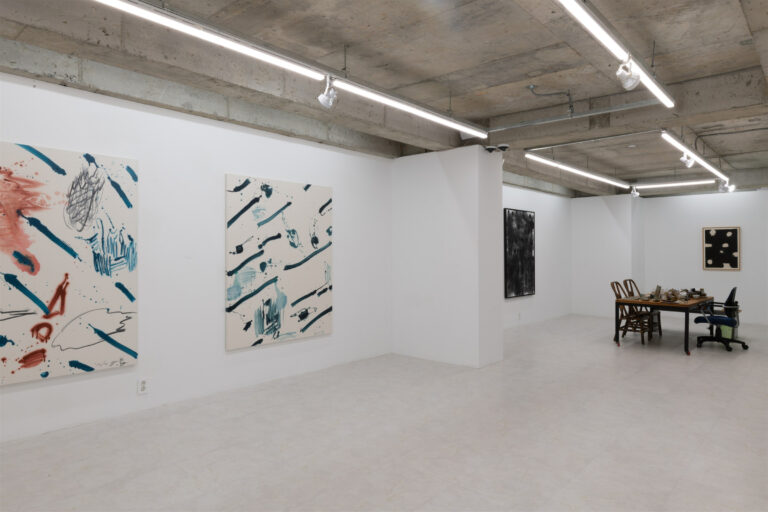
The “Northern Sea” of Lee’s paintings is not a geographical location. It is closer to a primordial realm where life first emerges before any form receives a name. While the image of a northern sea may evoke a distant and frozen landscape, in Lee’s work it becomes a site of continuous becoming. Here, forms are not completed but generated; lines do not describe objects but reveal traces of life; water and ink spread, gather, and resonate to create rhythms of a world yet to arrive.
In the *From the North Sea* series, Lee does not depict completed objects. Instead, he seeks to capture vibrations, resonances, and invisible movements that exist just before form emerges. Concrete imagery increasingly recedes from the surface, replaced by dynamic clusters of lines and traces that move freely between intention and spontaneity. Water absorbed into hanji, tonal variations of ink, and overlapping currents of line transform the painting into a field of becoming rather than a fixed image. Painting thus becomes not a representation of nature, but a place where the principles of nature’s formation may be experienced.
This sense of becoming is deeply connected to the artist’s daily life. For Lee, painting a mountain and sorting soil by hand in a small garden are not separate acts. Mountains and gardens, the cosmos and the palm of a hand, the depths of water and the texture of earth are not different worlds, but manifestations of the same vital movement appearing at different scales. A mountain may become a single tremor; a small garden may unfold with the vastness of cosmic creation. This reversal of scale reflects the ideas that Lee has long pursued through concepts such as *Sokuhi* (“not this, yet not other”) and the notion of a “Holy Paradox.” In his paintings, the small is never merely small, nor the large merely immense. The microscopic and the cosmic resonate together within a single living order.
In contrast, *Photosynthetic Human* reconsiders humanity not as a subject separated from nature, but as a being situated within the cycle of life. While photosynthesis refers to a biological process associated with plants, Lee expands the concept into a metaphor for human existence. Human beings are not self-contained entities, but lives sustained through light, water, air, earth, time, and breath. The series invites viewers to imagine humanity not as an observer of nature, but as a participant within its rhythms.
Here, human figures appear not as detached observers of landscape, but as sensorial beings that receive light, transmit water, and participate in the circulation of the world. Their forms are not fixed by rigid contours; instead, they remain open through lines, washes, movement, and empty space. Humanity becomes not the owner or interpreter of nature, but a presence that breathes, changes, and evolves alongside it. In doing so, the series challenges anthropocentric perspectives and reminds us that human beings are themselves one rhythm within a larger process of becoming.
Taken together, *From the North Sea* and *Photosynthetic Human* form two interconnected axes: origin and circulation. One turns toward the deep waters from which all forms arise; the other asks how humanity may once again find its place within that living order. They are not separate themes, but complementary dimensions of the ontological questions that have long animated Lee’s practice.
Although grounded in the materials and sensibilities of traditional East Asian painting, Lee’s work does not remain within the realm of tradition. Hanji, ink, water, and line evoke the principles of classical painting while simultaneously extending them into a contemporary field of thought. Ink diffusion, layered washes, tensions of line, and the depth of empty space become not devices for depicting nature, but events that reveal the processes through which the world comes into being and transforms. In Lee’s paintings, emptiness is never absence; it is a space where unnamed possibilities of life continue to reside.
In this sense, the exhibition represents a moment in which the artist’s long-standing formal experiments and philosophical inquiries achieve a renewed coherence. This is not a retrospective conclusion, but a process through which enduring questions acquire a new structure and vitality within his present work. Rather than seeking the completion of a fixed style, Lee continues to expand the relationships between water and ink, line and emptiness, nature and humanity, origin and circulation into a living system of thought.
*From the North Sea* is both a culmination and a new beginning. Through the intertwined series *From the North Sea* and *Photosynthetic Human*, Lee revisits the origins of life and the place of humanity within it. What emerges is not a painting that simply depicts nature, but one that invites us to enter the processes of nature’s generation and circulation themselves.